
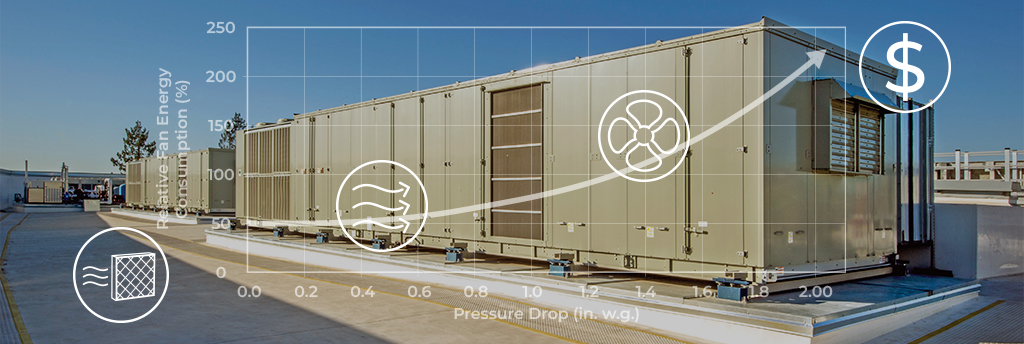
When evaluating air filters, efficiency ratings often dominate the conversation. MERV ratings, particle capture performance, and indoor air quality objectives all play an important role in filtration decisions.
But another factor can have just as much impact on overall HVAC performance and operating costs: pressure drop.
Every air filter creates resistance to airflow. As air passes through the filter media, energy is required to overcome that resistance and move conditioned air throughout the building. Pressure drop directly influences fan energy consumption, HVAC system performance, and total cost of ownership.
Understanding the relationship between filtration and pressure drop can help facility managers, engineers, and building owners make more informed decisions that balance air quality, energy efficiency, and operational costs.
What Is Pressure Drop?
Pressure drop is the reduction in air pressure that occurs as air moves through a filter. It is typically measured in inches of water gauge (in. w.g.) and represents the amount of resistance the HVAC system must overcome to maintain airflow.
Every filter has an initial pressure drop when it is clean. As the filter captures airborne particles and begins to load with dust, resistance increases, and pressure drop rises over time.
This is a normal part of filter operation. The challenge is that higher resistance requires fans to work harder, increasing energy consumption and placing additional strain on HVAC equipment.
While efficiency tells you how effectively a filter removes particles from the air, pressure drop helps determine the energy required to achieve that performance.
Want to learn more? Watch AAF Product Manager Kent Mertz explain what pressure drop is and why it matters in this short video: Understanding Filtration Measurement Terms: Pressure Drop
Why Pressure Drop Matters
In many commercial and industrial facilities, fan systems represent one of the largest energy consumers within the HVAC system. Even relatively small changes in resistance can create measurable differences in energy use over the life of a filter.
As pressure drop increases:
Because HVAC systems often run continuously, these impacts can accumulate significantly over the course of a year.
The result is that a filter with a lower resistance requires less fan energy to maintain airflow, potentially reducing operating costs over its service life.
Looking Beyond Filter Efficiency
Filter efficiency is essential, but it should not be the only specification considered during product selection.
When comparing mechanical filters with similar efficiency ratings, initial pressure drop provides an important indication of the energy required to move air through the clean filter. A filter with lower initial resistance places less demand on the HVAC system at the beginning of its service life and starts from a lower resistance as particulate accumulates.
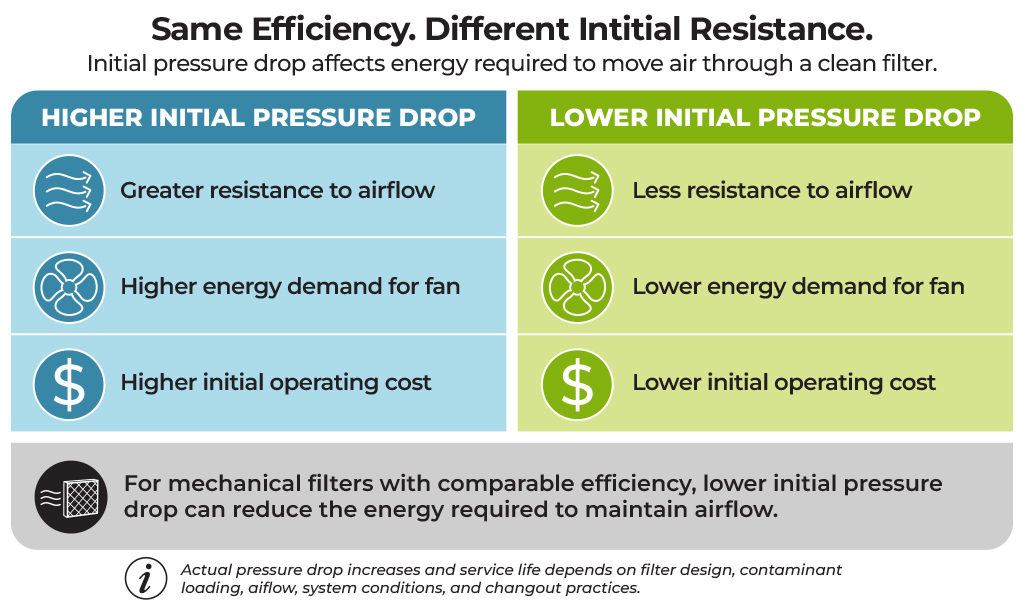
Actual pressure-drop increases and service life will vary based on several factors, including
For this reason, pressure drop should be evaluated alongside filtration efficiency, application requirements, and dust-holding capacity using comprehensive performance data provided by the filter manufacturer.
This broader evaluation helps facilities compare different filter options based on both particle-capture performance and the energy required to maintain airflow.
For a deeper look at another important aspect of long-term filter performance, read our Industry Insight on Dust Holding Capacity & the Hidden Drivers of Filter Performance
The Connection Between Pressure Drop and Energy
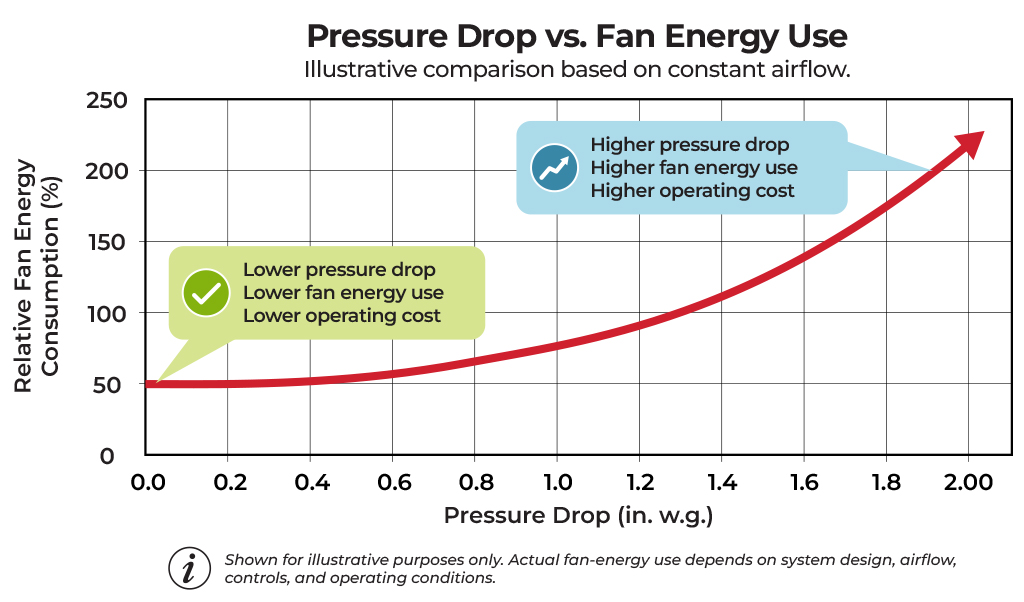 When an HVAC system compensates to maintain airflow, higher resistance requires more fan power. As filters load with particulate matter, resistance increases. In variable air volume systems, the fan may increase speed to maintain airflow, raising energy consumption. In systems operating at fixed fan speeds, airflow may decrease, potentially affecting ventilation rates, occupant comfort, and process performance.
Over thousands of operating hours each year, these energy impacts can become significant. This is particularly important in facilities with large HVAC systems, including:
In these environments, even modest reductions in pressure drop can translate into meaningful energy savings.
Designing for Lower Resistance
Several filter design characteristics influence pressure drop performance.
The Total Cost Perspective
Pressure drop is ultimately a total cost of ownership issue. A lower-cost filter may appear attractive based on purchase price alone, but higher energy consumption and maintenance requirements can offset some or all of the initial savings.
When evaluating filtration strategies, facilities should consider:
Looking at the complete operational picture often reveals opportunities to reduce costs while maintaining or improving indoor air quality.
The Bottom Line
Filter efficiency remains an essential part of any filtration strategy, but it is only one piece of the equation.
Pressure drop directly affects energy consumption, airflow performance, and long-term operating costs. By selecting filters that combine the required efficiency with lower airflow resistance, facilities can improve HVAC energy performance while supporting their indoor air quality goals.
The most effective filtration decisions are not based solely on the particle size a filter captures, but also on the energy required to deliver that performance.
Connect with an AAF expert to create a filtration strategy tailored to your facility’s needs.


