
As demand for AI workloads, cloud computing, hyperscale campuses, and edge infrastructure accelerates, data centers are scaling at an unprecedented pace. But as facilities grow larger, denser, and more geographically diverse, environmental risk scales with them.
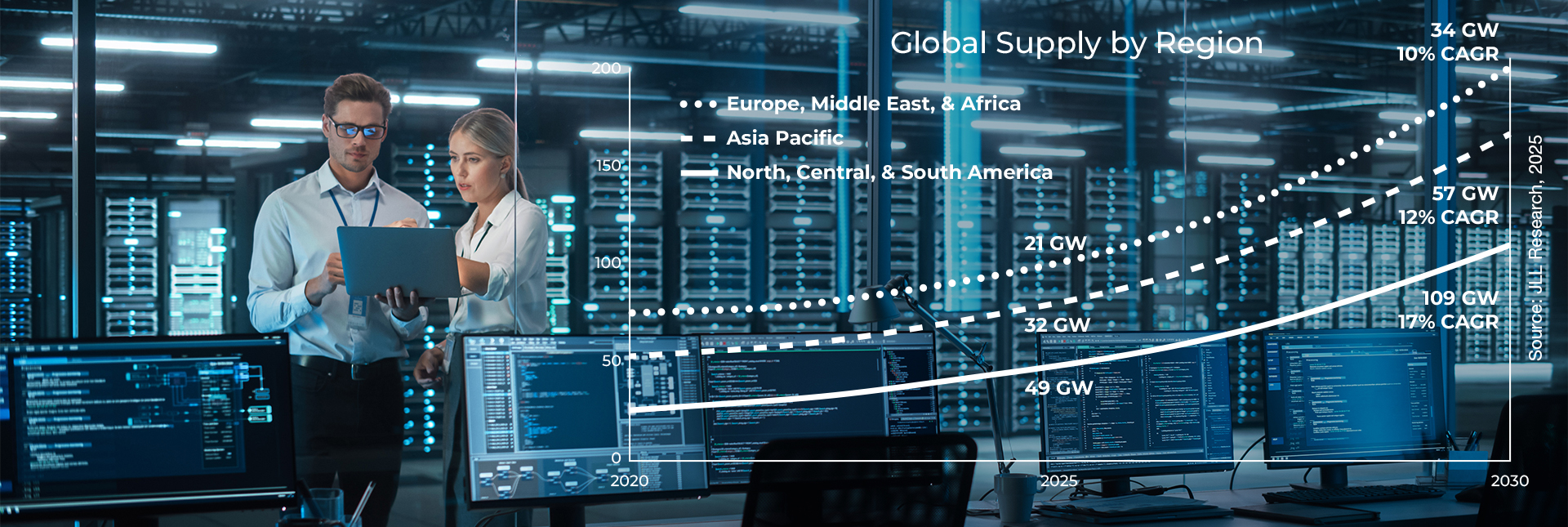
According to JLL’s Data Center Outlook, global data center capacity is projected to nearly double between 2025 and 2030, adding approximately 97 gigawatts of new capacity worldwide. That growth means significantly more air is being processed through mission-critical environments every day, increasing exposure to particulate and molecular contaminants.
As Data Centers become a critical part of our economy, the air within them is not a background utility. It is a strategic asset that directly impacts uptime, efficiency, and long-term asset protection.
Why Air Quality Is a Reliability Strategy
Data centers operate under continuous airflow with densely packed electronic equipment and zero tolerance for failure. Even low levels of airborne contamination can cause cumulative damage over time.
Poor indoor air quality (IAQ) can contribute to:
ASHRAE Technical Committee 9.9 identifies both particulate and gaseous contamination as significant environmental risks to IT equipment, reinforcing that contamination control must be designed into the facility not addressed reactively.
Air Filters for Data Centers: What Works
Download Data Center Filtration Table: 
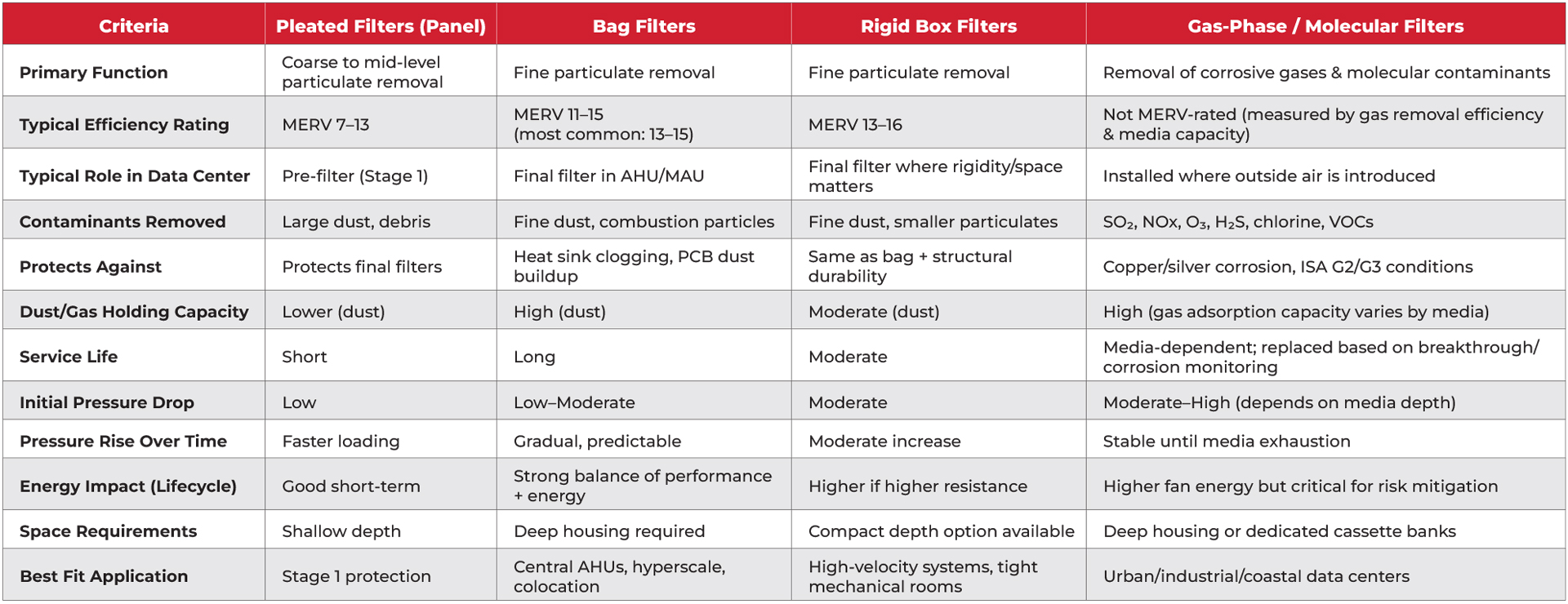
When evaluating air filters for data centers, particulate control is the first line of defense. Many facilities rely on bag filters, installed in air handling units and make-up air systems. These filters are widely used because they offer high dust-holding capacity and stable performance under continuous airflow.
However, not all bag filters perform equally.
In lower-risk environments, MERV 11 filtration may provide baseline protection. As server densities increase and equipment sensitivity grows, some operations now specify higher-efficiency ratings, such as MERV 13 to MERV 16, to reduce fine- and ultra-fine-particle deposition on electronics.
The challenge is balancing filtration efficiency with airflow performance. Higher MERV ratings can increase pressure drop, raising fan energy consumption and therefore the energy cost.
Best practice focuses on selecting high-efficiency filters engineered with:
The goal is to use a high-quality, high-efficiency filter with minimal energy penalty.
Balancing Filtration and Energy Performance
Energy efficiency remains a defining performance metric for data centers, commonly measured by Power Usage Effectiveness (PUE). While improved filtration enhances cleanliness, excessive pressure drop increases fan energy consumption.
An optimized filtration strategy considers:
Low-pressure-drop filter media and condition-based maintenance allow facilities to maintain cleanliness while minimizing energy impact.
Filtration should support both reliability and sustainability, not force a trade-off between the two.
Corrosion Control: Managing Molecular Contamination
Particulate filtration does not address corrosion control in data centers. Molecular contaminants, particularly corrosive gases, can infiltrate facilities through outside air or nearby industrial activity.
Gases such as sulfur dioxide (SO₂), hydrogen sulfide (H₂S), and nitrogen dioxide (NO₂) can lead to creep corrosion on printed circuit boards, resulting in intermittent and difficult-to-diagnose failures.
Standards such as ISA-71.04 classify corrosive environments and help determine acceptable exposure levels for electronic equipment. In environments where gas-phase contamination is present, molecular filtration becomes essential.
Gas-phase filtration systems typically use activated carbon or chemically treated media to remove corrosive gases before they reach IT equipment. When combined with particulate filtration, they form a comprehensive contamination control strategy that protects sensitive electronics from both solid and gaseous threats.
IAQ Monitoring and Proactive Risk Management
Leading operators are moving beyond calendar-based maintenance toward real-time environmental monitoring.
Common approaches include:
Continuous monitoring enables facilities to adjust filtration strategy based on actual risk conditions. This predictive approach strengthens uptime resilience and improves long-term operational control.
As wildfire smoke, dust events, and urban pollution become more frequent, dynamic IAQ management is increasingly important for data centers that rely on outside air economization.
The American Air Filter Approach
At American Air Filter, we recognize that air filtration in data centers is foundational to uptime, energy efficiency, and asset protection.
Our strategies integrate:
Beyond hardware, we help operators evaluate filtration strategy holistically, balancing MERV level, pressure drop, filter life, corrosion exposure, and energy performance to support both reliability and sustainability goals.
As a global leader in air filtration solutions for mission-critical environments, American Air Filter offers specialized expertise and products to safeguard your data center's operational integrity. Contact an AAF representative to design a filtration strategy tailored to your data center's specific needs.


